![]() |
|||
|
Exposure 101 Exposure is both the Art and Science of choosing the right combination of aperture, shutter speed, and ISO setting to get the photo you want. It is the combination of these three (the scientific side of exposure) that determines how light or dark your photos are, as well as the artistic "look" of your images. That is why an exposure decision is one of the most decisions you make when you create an image. There are three reasons it is important to understand exposure: 1. To get the exposure right (the science). 2. To get the "look" you want in your images (the art). 3. To know what to do in the situations when your camera meter gets it all wrong.
If too much light hits the digital sensor/film in your camera, your image will be overexposed and look too light or washed out. If not enough light hits the digital sensor or film, your image will be under exposed and look too dark. If just the right amount of light hits the sensor/film, your image will look just right. Getting your photos "just right", not too light and not too dark, is the scientific side of exposure. How do you do that? Using Exposure's "Big Three": Aperture, Shutter Speed, and ISO To get the exposure you want, you need to understand aperture settings (f-stops), shutter speeds, and ISO settings. Together, they determine the exposure for each of your photos. The aperture settings (indicated by f-stops) determine the size of the aperture opening inside the lens which controls the amount of light that can flow through the lens at any one moment in time. Wider apertures let in a flood of light, smaller apertures let in a trickle of light, and the middle apertures fall somewhere in between. The shutter speeds (indicated in seconds and fractions of a second) determine how long light flows into the camera. Since wider lens apertures let in more light, shutter speeds can be shorter. With smaller lens apertures that let in less light, shutter speeds need to be longer. The ISO setting of a digital camera determines how the camera processes the light that hits the sensor. Lower ISO speeds require more light to get the exposure you want and higher ISO settings need less light. At higher ISO speeds, a digital camera boosts the signal from the sensor so less light is needed to get the right exposure. Film with higher ISO speeds respond more quickly to the light than films with a lower ISO speeds. "Water Bucket" Exposure Getting the right amount of light on the digital sensor (or film) is like using a garden hose to fill a bucket with water. Too much water and the bucket overflows (overexposure). Too little and the bucket won't be full (under exposure). Using different lens apertures is like having garden hoses in different diameters. A huge garden hose will fill a bucket in less time than a tiny garden hose. Just like wide lens apertures need less time (shorter shutter speeds) to fill the digital sensor with light than a tiny lens aperture. Different ISO speeds is like having different sized water buckets. A low ISO setting is like having a big bucket to fill with water. A high ISO setting is like having a small bucket. It takes less water to fill a small bucket, and it takes less light to get the right exposure when you use a high ISO speed on your camera. I takes more water to fill a big bucket, and more light when you use a low ISO speed. It is easy to see when a water bucket is full of water. How do you know when enough light has hit your digital sensor or film? That is what light meters are for. Detailed information on using light meters can be found in the articles linked at the bottom of this page.
An exposure decision is also one of the most important artistic decisions you will make, because every exposure decision is also an artistic decision. In most photo situations, there are a lot of possible combinations of aperture, shutter speed, and ISO setting that will give you exactly the same exposure, but with very different artistic looks. If you turn all of your exposure decisions to the camera, you are also turning over all of the related artistic decisions to a computer chip. If more photographers knew this, they would take control of exposure themselves and make their own artistic decisions. Putting a camera on autopilot when it comes to exposure is one of the reasons so many photos end up with a reasonably good exposure, at least most of the time, but look so ordinary. Depth of Field The artistic side of exposure allows you to determine how much or how little depth of field (the near to far sharpness) you have in a photo. You can make one subject sharp in your photo, while everything else is soft and blurry. Or you can make everything sharp from inches in front of the camera to the distant horizon. Or do something in between. When you know how, the choice is yours. Experienced photographers use depth of field as one of their most powerful creative tools. Shutter Speed and Subject Motion The artistic side of exposure also allows you to determine how sharp or blurred the subjects and backgrounds are in your photos. By the right choice of shutter speeds, you can freeze a moment in time, or record the passage of time. You can have a blurred subject in front of a blurred background, or vice versa. Or both can be sharp or both blurred. It's your creative choice, provided you know how to combine the right shutter speed with the presence or absence of camera movement during the exposure.
Finally, there are some situations in which the camera just gets the exposure completely wrong. This often happens in some of the most dramatic lighting situations with the most creative artistic potential. Some of the best photographic moments never end up as a beautiful photo because the camera was on autopilot, instead of in the control of the photographer. Knowing how to control exposure in tricky situations is one of the keys to great photography. I am writing a series of articles (linked below) that cover the basics of exposure. As they appear, dig in and have fun!
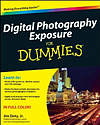
My most detailed and comprehensive coverage of the art and science of exposure is in my new photography book, Digital Photography Exposure for Dummies. In Parts I and II of the book, there are 10 chapters of information (220 pages in all) with exercises, photos and illustrations devoted entirely to the science and art of exposure. If you are a beginner, the book will quickly bring you up to speed. If you are well beyond the beginner phase, there are plenty of intermediate and advanced techniques for you to go out and try. In Parts III and IV, everything you experienced in Parts I and II will be applied to all kinds of photographic situations and topics. Go here to find out more.
Speaking Your Camera's Language: Aperture, Shutter Speed, and ISO Using Reflected Light Meters, Part One Using Reflected Light Meters, Part Two Simplify Your Life with an Incident Light Meter Turn Your Camera Meter Into An Incident Light Meter: Using an ExpoDisc Using a Gray Card, Incident Light Metering on the Cheap
December 22, 2010 |
|
Copyright © Jim Doty, Jr. All rights reserved. |
|
|
|
||||||||||||||||||||||||