|
|
|
|
|
|||
|
|
||||
|
Home > Learn > Why Is Metering So Important? > Using An 18% Gray Card Incident Light Metering on the Cheap:
The Gray Card Advantage You can have many of the advantages of a $300 - $400 incident light meter for less than $20. Sound too good to be true? It isn't. This is about as close as you can get to a photographic "free lunch". When I first got serious about metering (one of the first signs a photographer is getting serious about the quality of their work), I wanted an incident light meter but I couldn't afford one yet. So I did the next best thing at the time, I bought an 18% gray card. It was an excellent decision. I highly recommend you get a gray card if you don't have one yet. 18% gray cards are manufactured to exacting standards (or at least the good ones are). They are neutral in tone and reflect 18% of the light that falls on them. This gives you a known standard of reference. 18% is pretty close to the reflectivity standards to which most camera meters are calibrated. The challenge with reflected light meters (the kind that's inside your camera) is making allowances for subject tonality. Every subject that is lighter or darker than a medium tone (i.e., lighter or darker than a gray card), requires some exposure compensation, and most photographic subjects are lighter or darker than a medium tone. Exposure compensation means you have to vary from what your camera meter tells you if you want the best possible exposure. More about that here. If you are using your camera's built in meter, you have to vary from what that meter tells you most of the time. Using an 18% Gray Card For most subjects, a gray card makes that much simpler. Meter a gray card in the same light that is falling on your subject, lock in that meter reading, put away your gray card and photograph your subject. It is as simple as that, and it works for all but the lightest and darkest subjects. It is like incident light metering on the cheap. Technically, you aren't really doing incident light metering when you meter a gray card, you are using the reflected light meter in your camera. But when you meter a gray card, the meter reading should be the same as the one you would get if you pointed an expensive incident light meter at the light source (and for a small fraction of the cost). With a gray card, you are metering a subject with a set tonality (18% reflectance), making metering easier. There are a few things to keep in mind (there always are when it comes to any aspect of photography).
Exposure Compensation For medium toned, light toned, and dark toned subjects, no exposure compensation is necessary, at least theoretically. That's the good news. For very light and very dark toned subjects, some exposure compensation is necessary. Follow the same exposure compensation suggestions you would use if you were using an incident light meter. Subtract about 1/2 of light from what the gray card meter reading tells you for bright white subjects (like sunlit snow). Check the histogram. If you have burned out pixels, subtract a full stop (-1) from your gray card reading and take the picture again. Add about a stop of light to what the gray card meter reading tells you for very dark toned subjects (like a gorilla or a black locomotive). Where to "Point" the Gray Card Just like using an incident light meter, the direction you "point" the surface of the gray card is important, even more important than with an incident light meter. In most situations, you will want to have the gray card facing the most important light source. If you are doing photos of sidelit subjects, the sun should be behind your back and the gray card should be facing the sun as you meter it's surface. Once you lock in the meter reading, turn and face your sidelit subject and take the picture. The sunlit side of your subject will be properly exposed, the shady side will be underexposed.
In this sidelit photo of Denali I turned my back to the sun so the gray side of my gray card was facing the sunlight. I metered the surface of the gray card and locked in that exposure. Then I turned to face Denali and took the picture. The sunlit side of Denali is properly exposed and the shady side is underexposed, just like it looked in real life. If you are in a situation where you want to base the exposure on the shady side of your subject, then you should face the sun and the gray card will be facing away from the sun as you meter the gray surface. The shady side of your subject will be properly exposed and the sunlit side will be overexposed. The same is true of backlit subjects. Face the sun and the gray card will be facing away from the sun as you meter the gray surface.
This girl is backlit by the sun. The right way to use a gray card in this situation is to face the sun and meter the surface of the gray card as it is facing away from the sun. Lock in that meter reading (so the camera meter isn't fooled by the bright sunlit grass) and take the picture. Using a Gray Card to Learn Subject Tonality A gray card is a great way to learn all about subject tonality. Put your camera in aperture priority mode and set the f-stop to f/8. Meter the gray card and then meter your subject and compare shutter speeds. You will soon learn how much lighter or darker your subject is from a medium gray. Mastering subject tonality is a big step toward becoming a better photographer. Some tonality examples: If the gray card metering reading (at f/8) is 1/500 and the meter reading of snow in the same light (at f/8) is 1/2000, you know that the snow is two stops lighter than a medium tone (faster shutter speeds mean lighter subjects). If the gray card reading is 1/60 and the meter reading of a sandy beach in the same light is 1/125, the sand is one stop lighter than a medium tone. If the gray card reading is 1/90 and the meter reading for some orange flowers in the same light is 1/60, the orange flowers are 1/2 stop darker than a medium tone (longer shutter speeds mean darker subjects). The more you practice, the better you will get. When you can predict how much lighter or darker a subject is than a medium tone with about 1/2 stop of accuracy, you can retire your gray card! Setting Your Camera's Custom White Balance with A Gray Card Because a gray card is manufactured to be neutral in tone, a gray card is one of the
best ways to set the "custom white balance" on your camera. (Some cameras don't allow you to set a custom white balance so check the manual to see if you have this
excellent feature.) Meter the gray card in the same light as your subject and take a picture of it. The photo doesn't need to be in focus but it does need to fill the frame
so nothing shows but the gray card. Using the instructions in your camera's manual (every camera does this a little differently), use the photo of the gray card to set
the custom white balance. Be sure and change the white balance on your camera's dial or menu to "Custom White Balance". Once the white balance has been set,
meter the gray card again (changing the white balance can change the exposure). Now you are ready to take pictures. If the color of the light changes, you will need
to set the white balance again. If the intensity of the light changes, reset the custom white balance as well as the exposure.
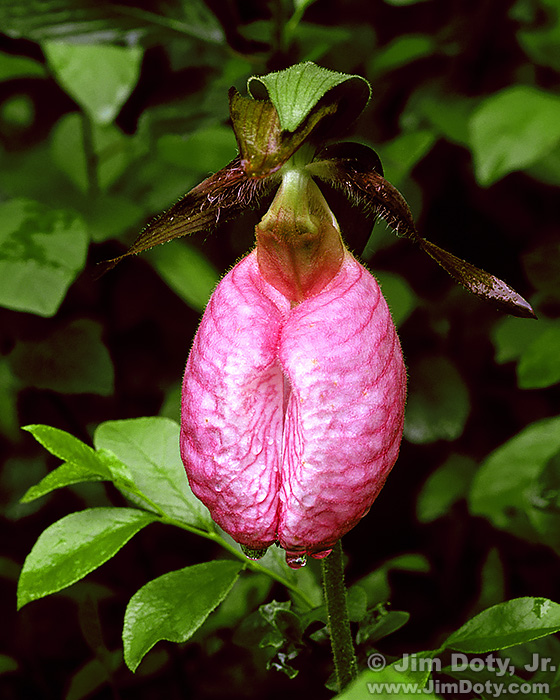
Pink Ladyslipper Orchid
In the orchid photo above, the dark green leaves in the background would throw off a camera meter and the orchid would be overexposed. It is a perfect situation for using a gray card. With my camera on a tripod and my lens focused on the orchid, I turned off autofocus and put a gray card in between the orchid and my lens. With the gray card angled slightly up to catch the light from the gray sky (the primary light source), I metered the gray card and locked in the exposure reading. Then I moved the gray card out of the way and photographed the orchid. It is important to turn off autofocus before using a gray card. As many lenses focus closer, they get longer, the light gets darker and the exposure changes. The lens, in essence, becomes a tunnel and the longer the tunnel, the darker it gets. Some lenses (especially macro lenses) will lose one or two stops of light as they approach the point of closest focus. If you focus on the gray card, the lens gets longer and the exposure changes. Remember to focus on the subject, turn off autofocus, meter the gray card in the same light as the subject, lock in the exposure, then take the picture. A Gray Card VS An Incident Light Meter A gray card is easier to carry than an incident light meter, it has no breakable moving parts or delicate electronics, it doesn't need a battery, and it costs a small fraction of the price of an incident light meter. A gray card is the simplest way to learn about subject tonality, and you can use it to set a very accurate white balance on a digital camera (something an incident light meter can't do). So why own an incident light meter? Two very good reasons. (1) If your camera meter dies, you can use an incident light meter as a backup meter. (2) An incident light meter is less directionally sensitive than a gray card. It matters in general where you point the white dome of an incident light meter (toward the light source, away from the light source or somewhere in between) but the exact angle doesn't matter that much due to the round light gathering dome. But the angle of a gray card is far more directionally sensitive and it is important that the angle is much closer to the right direction than is true with an incident light meter. (3) Most incident light meters have a built in flash meter. Gray cards can't directly measure flash output. (You can cheat and photograph a gray card with a flash unit and check the histogram on the back of a digital camera, but that is a whole other topic.) If you have both, which do you carry with you? Either or both. It depends on how light you are traveling and whether or not you need to have a backup meter. If you are using manual flash, the incident light meter is the best way to go. The Gray Card Versus Camera Meter Reflectivity Difference Supposedly, camera meter reflectivity is close enough to the 18% gray card standard as to not make much of a difference. But many camera meters are calibrated much closer to a 12% reflectance standard, or about a 1/2 stop difference from a gray card. To be technically accurate when using a gray card, you would add 1/2 stop of light to every meter reading you get when using a gray card. Practically speaking, you may not need to do that. If you use an 18% gray card on a regular basis and find your images are consistently a little dark, add one half stop of exposure compensation (+1/2) to your gray card meter readings. If you use a gray card and your images look just fine, there is no need for you to do the +1/2 compensation. Recommendations: Buying a Gray Card
Speaking Your Camera's Exposure Language: Aperture, Shutter Speed, and ISO Using Reflected Light Meters, Part One Using Reflected Light Meters, Part Two Simplify Your Life with an Incident Light Meter Turn Your Camera Meter Into An Incident Light Meter: Using an ExpoDisc Using a Gray Card, Incident Light Metering on the Cheap The RAW versus Jpeg Exposure Advantage
More Information The most detailed information about using incident light meters, gray cards, and camera meters is in my book, Digital Photography Exposure for Dummies.
February 17, 2011 |
|
|
|
[Home] [About] [Photos] [Learn] [Blog] [Portraits.JimDoty.com] [Contact] |
|
|
|
Copyright © Jim Doty, Jr. All rights reserved. |
|
|
|
||||||||||||||||||||||||